What industrial laboratories really need  

Formulation management software for R&D teams

Formulation development generates valuable data every day, from raw-material specifications and trial parameters to test results and batch records. In many industrial laboratories, however, this information remains scattered across spreadsheets, local network drives and knowledge silos held by individual employees.


Materialentwickler vergleicht Tabellenstände, Laborbuch und beschriftete Materialproben manuell.
From data silos to usable knowledge

When knowledge is hard to find

Every new formulation begins with a question: What have we already tested?

Without a central data foundation, answering this question quickly turns into a time-consuming, manual process. Relevant insights remain hidden, assessing raw-material changes requires extensive manual searches, and valuable knowledge leaves the organisation when experienced employees depart.


More than storing formulations

What to look for in a formulation management software

This is where dedicated formulation management software comes in, though not every solution addresses the requirements of industrial R&D teams, particularly when formulation data must be connected with test results, raw-material histories and process parameters.

Zwei Enwickler in der Klebstoffindustrie analysieren Formulierungsdaten und werten diese aus.
Entwickler in der Klebstoffindustrie arbeitet an einer neuen Klebstoffformulierung.
Connected data instead of isolated information

What formulation management software should deliver for industrial R&D

Storing formulation data is the starting point, not the objective. A solution designed for industrial R&D must connect formulations within their complete development context, including raw materials, trial series, test results and batch documentation.

As a Material Intelligence platform, LabV is built exactly for this. The capabilities below demonstrate what this means in practice.

Before / After

How structured formulation management changes R&D in practice

Without structured formulation management

Formulation data distributed across multiple spreadsheets, often named by date or the developer's initials

Test results stored separately in Excel sheets or as PDF files

Links between formulation variants and test results established manually

Critical expertise and development knowledge leaving the organisation when experienced employees depart

Manual searches across every file triggered by raw-material changes  

With LabV

Formulations, raw materials, trial parameters and test results are captured systematically within a single platform and linked to one another.

Historical formulation data is searchable, enabling teams to answer questions within minutes: Which formulations contained raw material X? Which batches produced test value Y?

New development projects build on existing knowledge rather than starting from scratch.

Teams can analyse the potential impact of a raw-material change across the formulation portfolio in just a few clicks.

Data from laboratory instruments, LIMS platforms and manual entries flows into a shared data foundation.

Industry applications

Which industries and use cases is LabV designed for?

A central data foundation for formulations

LabV captures formulations, raw-material variants and trial records systematically in one central environment. Each formulation is connected with its raw materials, corresponding test results and wider development context.

Data integration across system boundaries

LabV connects existing systems and data sources, including laboratory instruments, databases, ELN platforms and spreadsheets, within an integrated data foundation. Information is automatically collected in the central platform, connected and available for analysis and informed decision-making.

Rapid comparison of formulation variants

R&D teams can compare formulation variants directly within the platform and instantly identify which formulations deliver the strongest results under specific test conditions. This analysis reveals relationships that are difficult to detect when data remains fragmented across multiple systems.

AI-supported analysis

Using structured formulation data, LabV provides AI-supported analyses that reveal relationships, for example between raw-material variables and product properties. These analyses can highlight promising development paths and identify anomalies in test series at an early stage.

End-to-end traceability

LabV provides a traceable record of formulation decisions, including the raw materials and batches used, the test results achieved, the changes made and the individuals responsible.

Industry applications

Which industries and use cases is LabV designed for?

LabV is particularly relevant in formulation management of industrial product-development teams.  

Further Reading

More on formulation management

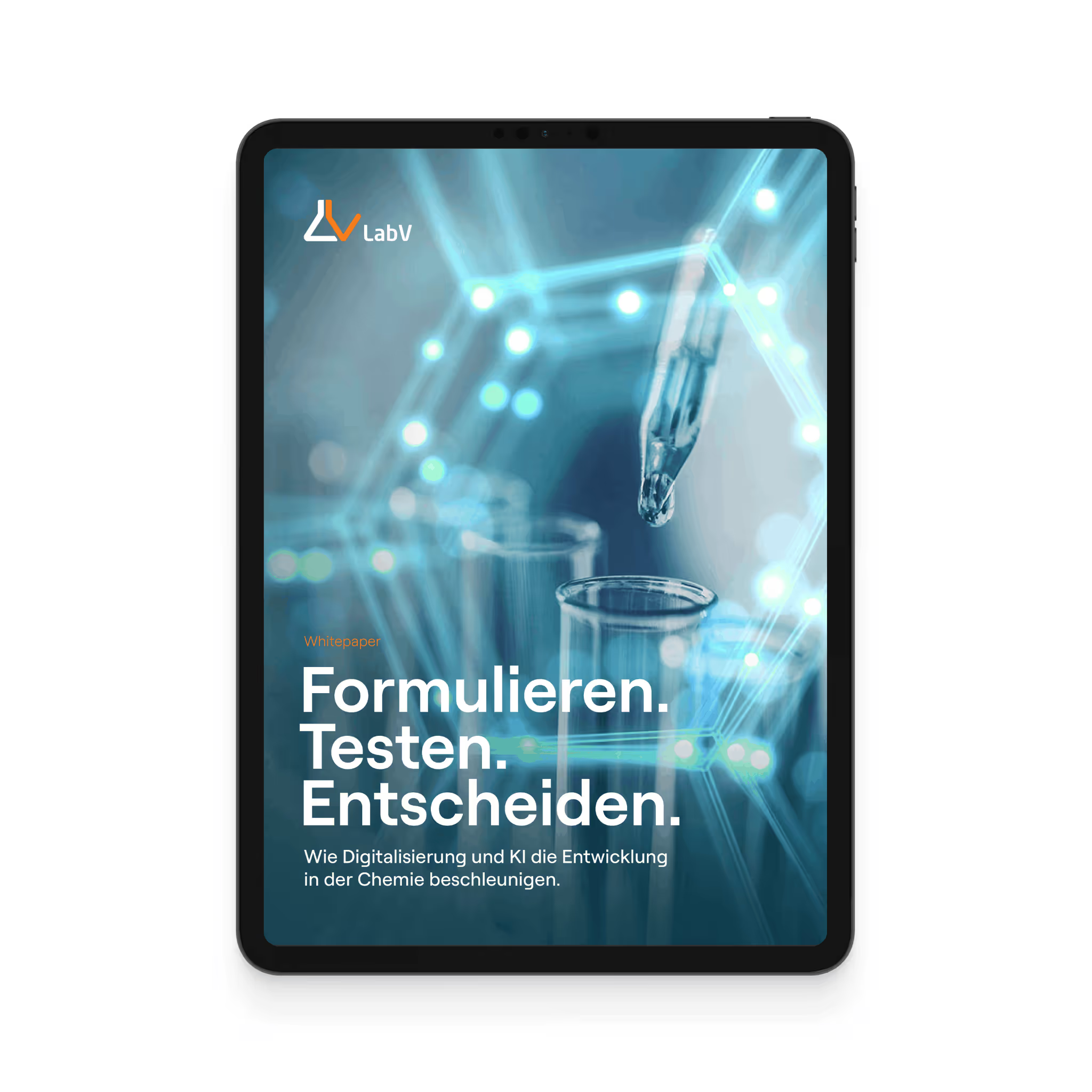
Tablet zeigt ein Laborbild mit einem Tropfen, der in ein Reagenzglas fällt, und den Text „Formulieren. Testen. Entscheiden. Wie Digitalisierung und KI die Entwicklung in der Chemie beschleunigen.“
Whitepaper

Formulate. Test. Decide.

How digitalisation and AI accelerate formulation development in the chemical industry.

Discover whitepaper
Tablet mit einem Case Study Deckblatt von LabV, Titel: Von Excel zur Material Intelligence, mit Bild von schwarzen und blauen Kunststoffgranulaten.
Case Study

From Excel to Material Intelligence

A practical example: connecting laboratory, raw-material and test data and analysing it faster with AI.

Discover case studies
Glossary

What is formulation management?

Definition, core tasks and distinction from broader formulation development.

Classify term
LabV Charles JouaniqueTobias HeinrichLabV Daniel Stroh

Find out what a formulation management software looks like in practice.

Book a free 45 minute demo and see how LabV simplifies complex processes, connects data effortlessly, and makes everyday lab work noticeably easier through an intuitive interface.