The foundation for data-driven material development

Material Intelligence

Material Intelligence refers to the systematic use of data, AI and workflows to better understand, optimise and advance materials. A Material Intelligence platform provides the infrastructure that lets development teams make decisions based on complete, integrated data, rather than a fragmented landscape of scattered files and undocumented experience.
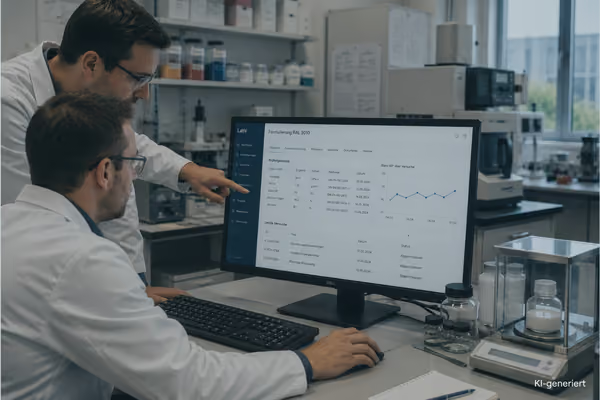

Materialentwicklerin dokumentiert Versuchsergebnisse neben einer strukturierten LabV-Datenauswertung.
What lies behind the term

Linking data, gaining insights

The term rests on one principle: data from formulation trials, test equipment, process parameters and quality checks is systematically linked and made usable, regardless of which system it was generated in. Anyone working on this basis shifts their focus from where data is located to what insights can be gained from it.

Fragmented data as the starting point

What Material Intelligence means

Data management in the lab is nothing new. Most labs already rely on LIMS systems, ELN tools, test reports and spreadsheets. Volume is rarely the problem - it’s the fragmentation: data exists side by side without being structurally connected.

Measurement values sit in proprietary instrument formats, formulations in local spreadsheets, and experiment records in lab notebooks or PDFs. Test results are stored in LIMS databases, disconnected from the formulation data behind them. This is exactly where Material Intelligence comes in.

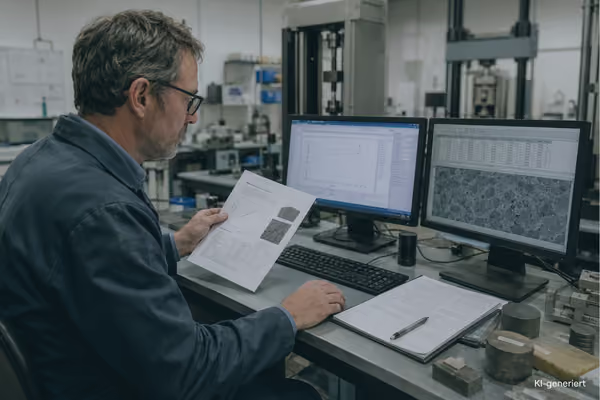
Materialforscher gleicht getrennte Prüfdaten auf zwei Systemen und einem Papierbericht ab.
LIMS, ELN and Excel compared

Why classic lab software is insufficient

Teams in industrial R&D today typically work with a combination of LIMS, ELN and Excel. Each of these tools solves specific problems, but none brings formulation data, process parameters and test results together in one shared, analysable database. Material Intelligence adds an overarching layer to these categories. In practice, this means a platform that integrates data from LIMS, ELN and other sources, and makes it analysable.

LIMS

Laboratory Information Management Systems (LIMS) are designed for sample management, documentation and traceability. They work well in quality assurance, where standardised processes are the priority. In exploratory R&D, they reach conceptual limits.

ELN

Electronic Lab Notebooks (ELN) digitalisieren die Labordokumentation. Sie ersetzen das papierbasierte Laborbuch und schaffen mehr Struktur in der Versuchsdokumentation. Als Dokumentationswerkzeug erfüllen sie ihren Zweck. Daten, die im ELN erfasst sind, sind damit jedoch noch nicht mit anderen Datenquellen verknüpft oder auswertbar.

Excel

In many R&D departments, Excel remains the tool of choice for formulation data, experiment records and ad hoc analyses. For systematic data management across projects and teams, however, it lacks the structural foundations: no version control, no linkage with raw data and no audit trail. Excel does not connect systems: it bridges the gaps between them.

How it works

The three levels of Material Intelligence

Material Intelligence rests on three levels that build on one another: data, workflows and Artificial Intelligence (AI).

01

Data

Data integration in the laboratory means the automatic transfer of measurement data, formulations, process parameters and quality results from different systems and formats into a shared database. Test equipment, LIMS databases, ELN systems and external sources feed their data into a central environment, where it is linked and becomes analysable.

02

Workflows

A measurement value gains significance through the context in which it was created: Which formulation was used? Which batch? Which process conditions? Material Intelligence establishes this context systematically and keeps it accessible long after the measurement was taken.

03

AI

On the basis of structured, complete data, AI becomes a practically applicable tool in the laboratory: pattern recognition in large experimental data sets, automated variant comparison and predictive models for material properties. Levels 1 and 2 create the foundation for this. LabVs Material Intelligence platform builds on these three levels.

Use Cases

Material Intelligence in industrial practice

The approach applies across industries, but its application depends on the specific challenges each development team faces.

Material Intelligence and the EU AI Act

The EU AI Act is progressively introducing binding requirements for AI systems in industry, R&D included. As a result, transparency, traceability and data quality are becoming regulatory obligations. As a European platform, LabV stores data on servers in the EU and in accordance with GDPR standards.

LabV Charles JouaniqueTobias HeinrichLabV Daniel Stroh

Find out what Material Intelligence looks like in practice

Book a free 45 minute demo and see how LabV simplifies complex processes, connects data effortlessly, and makes everyday lab work noticeably easier through an intuitive interface.