The growing use of recyclates is fundamentally changing material development. While virgin raw materials typically have a consistent chemical composition and clearly defined physical properties, recyclates bring a new reality to R&D: variability at multiple levels.
This variability shows up between different deliveries, and often within a single batch as well. Development teams can no longer treat once-reliable assumptions as fixed; they now need continuous verification.
That raises a central question: can well-founded results and well-founded decisions still be ensured under these conditions? More experiments aren't the answer. What matters is the ability to capture, connect and analyse structured data systematically.
When variability meets conventional formulation development
Formulation development for polymer-based materials is often built on iterative cycles: adjust the formulation, test it and evaluate the results. This approach is efficient as long as material quality stays consistent.
With recyclates, however, the number of relevant influencing factors increases considerably. Typical variations affect:
- Molecular weight distribution (for example through chain degradation or chain extension caused by thermal and mechanical stress during the recycling process)
- Residual additives from previous applications (such as stabilisers, plasticisers, flame retardants)
- Foreign polymers (compatibility and phase separation issues)
- Contaminants (such as colour pigments, metals or dirt)
- Thermal and mechanical ageing (such as oxidation, hydrolysis)
These factors directly affect:
- Rheological properties (such as viscosity and flow behaviour)
- Thermal properties (such as glass transition and melting behaviour)
- Mechanical performance and processability
- Optical properties (such as colour and transparency)
Practical example: A compounder replaces a share of virgin polymer with a recyclate. At lab scale, processing reveals increased viscosity. An initial hypothesis: a changed molecular weight distribution, though residual additives or foreign polymers with a higher molecular weight could also be the cause.
However, no comparable historical measurement data exists to confirm or rule out this assumption. At the same time, relevant process parameters from earlier trials are not clearly documented.
The team responds by running new trial series, because the information needed exists within the company, but is not accessible or linked.
The real problem: missing data integration
Many organisations hold large volumes of data from:
- Material characterisation
- Process development
- Application testing
- Quality assurance
The problem rarely lies in the volume of data, but in its structure:
- Measurement data from FTIR spectroscopy or rheometry is stored separately
- Formulations sit in Excel spreadsheets or lab notebooks
- Process parameters are documented in machine systems or separate tools
This fragmentation prevents relationships from being recognised.
Concrete scenario: A team analyses two recyclate batches using FTIR. The spectra show differences in certain functional groups. Rheological measurements carried out in parallel show a deviation in flow behaviour.
Without connected data structures, it remains unclear:
- Which formulation was used exactly?
- What process conditions applied?
- Is there a correlation between the spectra and the rheological properties?
The data exists, but it cannot be used for decision-making.
Trial planning only works with data
Structured experimental design (Design of Experiments, DoE) is a proven approach for investigating complex systems efficiently. It helps vary influencing factors in a targeted way and reveals interactions.
Here too, the value of a trial series depends on its design and on how well its results can be used afterwards.
Material characterisation as part of a wider process
Material characterisation delivers key information about material systems:
- FTIR spectroscopy → chemical structure
- Rheometry → flow behaviour and rheological properties
- DSC → thermal properties
- GPC → molecular weight distribution
These methods are established. Their full potential, however, is often not realised, because the measurement data they generate is not systematically linked to:
- Formulation variants
- Process parameters
- Application results
Example: Two materials show identical FTIR spectra but different processing properties. Linking this with process data reveals that the differences result from different shear histories during processing.
Without integrated data, this relationship remains hidden. This shows that data capture alone is not enough. What matters is its systematic connection with other information. This is where the concept of Material Intelligence comes in.
It refers to an approach in which data from material characterisation, formulation development and process parameters is brought together in shared data structures, so that relationships become traceable and usable. The goal is to assess material behaviour in the context of all relevant influencing factors and use this as a foundation for data-based decisions.
From fragmented data to structured data spaces
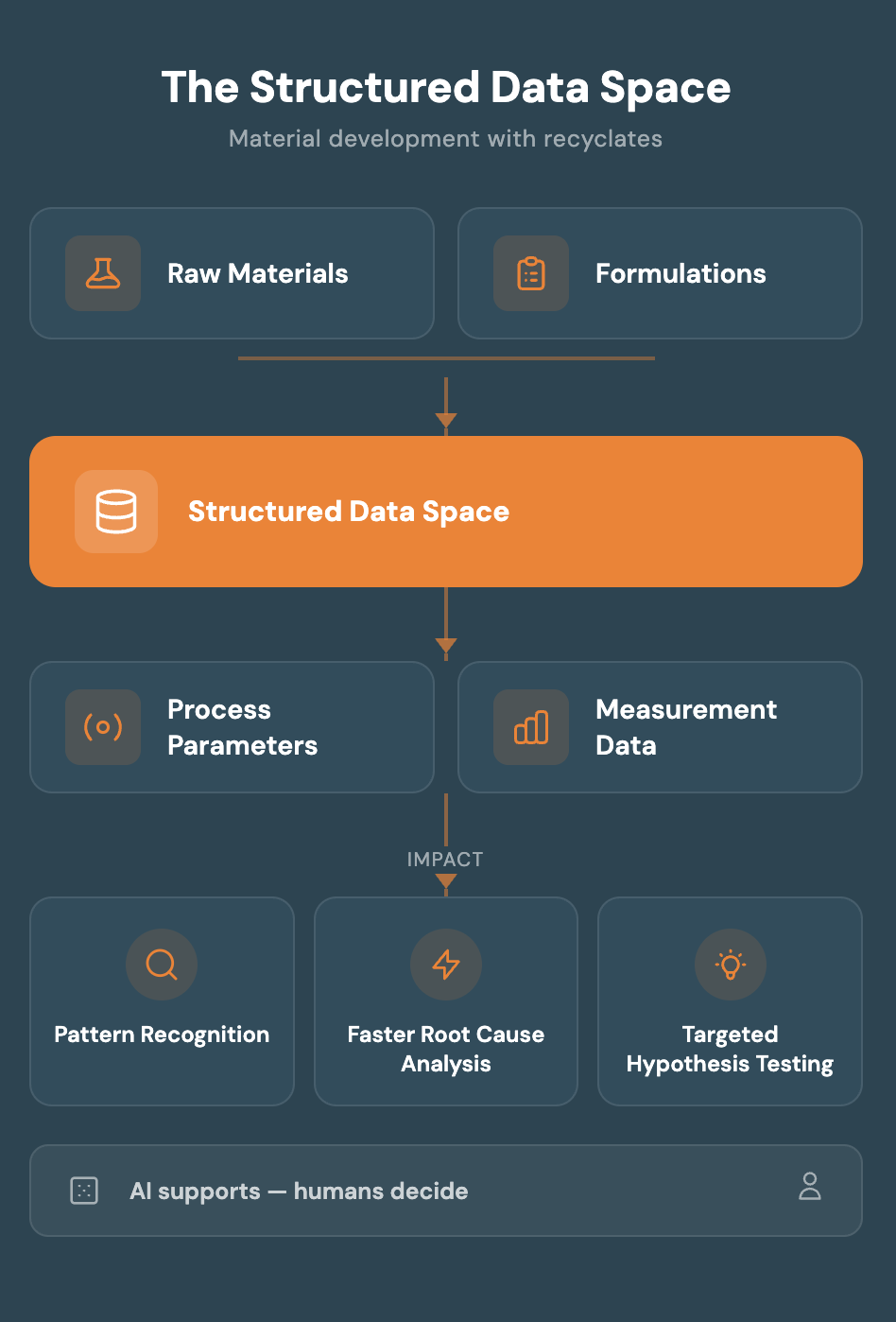
Making this complexity manageable takes more than data storage. It takes structured data spaces that connect information and place it in context.
A data space like this connects:
- Raw materials and their chemical composition
- Formulations from formulation development
- Process parameters from processing
- Measurement data from material characterisation
Within this structure, pattern recognition becomes possible.
In concrete terms, this means:
- Recurring relationships become visible
- Deviations can be explained faster
- Hypotheses can be tested in a more targeted way
Important: AI methods support this pattern recognition without replacing scientific judgement. Decisions remain with the R&D team.
What makes the difference in practice
Building data spaces like this relies on consistent principles rather than a perfect solution:
- Uniform data structures for materials, trials and results
- Direct links between measurement data, formulations and process parameters
- A traceable history in formulation development
- Systems that integrate into existing workflows
Practical example: A company introduces a central database in which every formulation is automatically linked to its associated measurement data and process parameters.
After a few months, the results show:
- The number of unnecessary experiments decreases
- Deviations can be explained faster
- New materials can be developed in a more targeted way
Regulation is tightening the requirements
External requirements such as REACH or the Digital Product Passport are also increasing the pressure to document material data in a traceable way.
This affects, in particular:
- The origin and composition of materials
- Processing steps
- Evidence of material properties
Companies with integrated data spaces have an advantage here, since the relevant information is already structured.
From reactive to predictive development
As data quality improves, the role of R&D changes fundamentally.
Instead of working purely reactively, teams can increasingly:
- Assess material behaviour based on existing data
- Formulate hypotheses in a targeted way
- Plan experiments more efficiently
Example: Based on historical data, a team identifies certain combinations of molecular weight distribution and additive content that lead to unstable rheological properties. New formulations can then be adjusted in a targeted way before extensive lab testing becomes necessary.
Conclusion
The use of recyclates makes visible what holds true for material development in general: insight comes from structure and connection, not from data alone.
Structured data, consistent data integration and connected data spaces create the foundation for:
- Reproducible and traceable development processes
- Well-founded decisions
- Efficient use of existing information
In this context, Material Intelligence describes the ability to connect data, workflows and AI so that material behaviour is not viewed in isolation, but understood in its full context and used as a basis for well-founded decisions.