.avif)
Regulatory pressure, volatile raw material markets, rising sustainability requirements and ever-shorter innovation cycles are reshaping chemical research and development. Products are becoming more complex, while development timelines shrink and budgets remain under scrutiny.
For R&D leaders, this means making faster decisions without compromising their quality, reliability or reproducibility.
The decisive lever does not lie in the testing laboratory. It lies in how consistently development data is structured, connected and made usable. This is exactly where professional R&D data management begins.
Data silos in R&D: the invisible efficiency loss
In many laboratories, delays are not caused by a lack of expertise but by fragmented information structures:
- A promising formulation has already been tested, but the results cannot be found.
- An experiment is repeated because previous trials were not documented transparently.
- Decision-relevant parameters have to be painstakingly assembled from different systems.
Data silos like these cost time, resources and innovation speed. They increase project risks and make robust decision-making more difficult.
What is missing is end-to-end knowledge management in the laboratory. Development knowledge often remains tied to individual projects, individual people or isolated files. As a result, valuable know-how cannot be used effectively across the organisation.
Without a structured data foundation, long-term competitiveness becomes difficult to sustain.
Why conventional systems reach their limits
LIMS, electronic laboratory notebooks and Excel-based data management fulfil important roles in documentation and quality assurance. They are essential for compliance and auditability.
Modern R&D, however, follows a different logic. It is iterative, exploratory and project-driven. Variants need to be compared, hypotheses evolve, and raw materials and process parameters interact in complex ways.
A conventional LIMS is designed primarily for standardised, repeatable processes. For innovation-driven development, that approach is often insufficient.
This is why many companies are looking for a LIMS alternative, particularly in chemical R&D. Such a platform needs to do more than document information. It must reveal relationships, structure projects and intelligently connect development data. This is exactly where a modern R&D data platform comes in.
Implementing R&D digitalisation strategically
R&D digitalisation does not mean transferring analogue processes into software one-to-one. It means redesigning information flows and systematically centralising material data.
An integrated R&D data platform brings together:
- Measurement data from laboratory instruments
- Process parameters
- Raw material information
- Project and experimental data
- Analysis and test results
Only when this data is placed in context and made centrally available does real transparency emerge. Development projects can be managed consistently from initiation to completion. Variants become comparable. Decisions are documented in a traceable manner.
This transforms R&D data management from an administrative task into a strategic instrument for steering and prioritisation.
R&D workflow management: structure creates speed
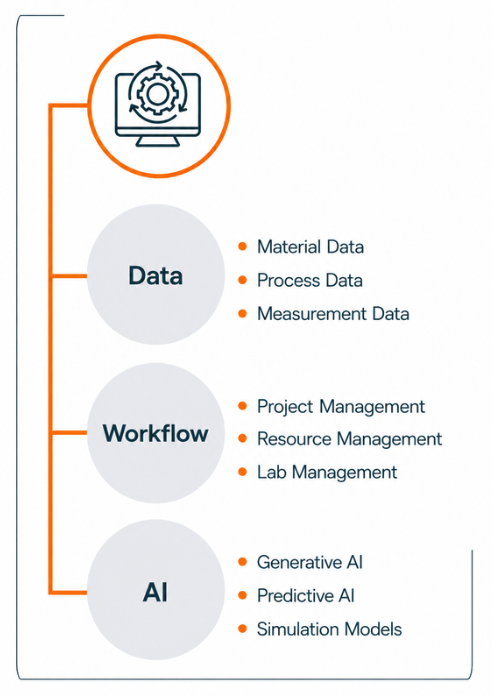
Efficient R&D depends not only on well-structured data, but also on well-designed processes. An effective workflow management reflects the reality of laboratory work: flexible, project-based and interdisciplinary. Development projects are clearly structured, responsibilities are transparent, and iterations are documented in a traceable way.
This reduces friction and creates:
- Transparency across project progress
- Faster alignment between teams
- Comparability of experimental series
- Greater planning reliability
Structured data and clearly defined workflows reinforce one another. Without a robust data foundation, every process remains incomplete. Without transparent processes, even high-quality data loses its value.
AI in material development: from analysis to prediction
Only a consistent data architecture enables AI in material development to reach its potential.
Structured, centralised development data makes it possible to identify patterns, uncover relationships and test hypotheses based on data.
An AI assistant can search development data, compare parameters or identify raw material alternatives. Beyond this, models can be trained to identify relationships between raw material combinations, process parameters and performance characteristics.
This shifts the focus from analysing the past towards anticipating future developments.
AI does not replace domain expertise. It supports technical experts and decision-makers by improving the basis for decisions, clarifying priorities and reducing uncertainty.
Measurable effects of an integrated data platform
Companies that centralise their material data and consistently eliminate data silos in R&D report significant improvements:
- Around 30 per cent fewer iteration cycles per project
- Noticeably less documentation effort
- Significantly less time spent searching for data
- Greater reproducibility and transparency
Beyond efficiency gains, this creates strategic confidence. Decisions are no longer based on isolated pieces of information, but on a consistent data foundation. This makes digitalisation a measurable contributor to speed, quality and competitiveness in R&D.
Conclusion: Structured data leads to better decisions
Data has long been available in chemical research. The difference lies in how systematically it is connected and made usable.
Professional R&D data management, an integrated data platform and the targeted use of AI in material development do more than improve individual processes. They enable R&D teams to make better-informed decisions, identify risks earlier and drive innovation more effectively. Companies that structure their development data strategically today will operate with greater confidence, efficiency and innovative strength than their competitors tomorrow.
The question is no longer whether R&D needs to be digitalised. The real question is: How systematically are your data being used today?
Autor: Dr. Marc Egelhofer