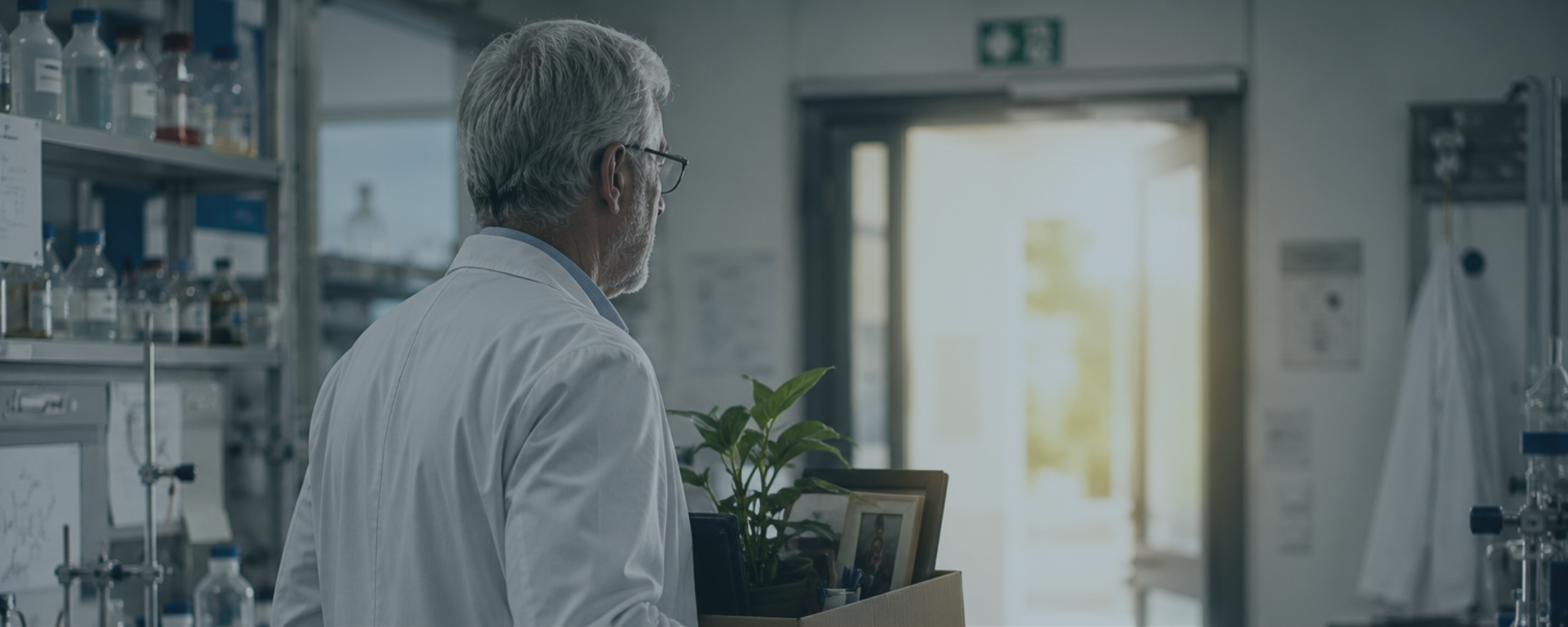
13.4 million people in Germany's workforce will retire by 2039, almost a third of those currently in employment. Only around 12.5 million younger workers are expected to take their place (Federal Statistical Office, August 2025). In industrial R&D, this issue is rarely discussed, even though the consequences weigh especially heavily there.
Why labs are affected differently than other departments
In R&D, the challenge goes beyond capacity. It is the experience built up over years that cannot simply be handed over. This shows up in the judgement a developer forms before ever reading the trial results, or in the sense that a raw material batch is behaving differently from the last one, long before that sense can be expressed as a figure.
Concrete questions that make up this knowledge:
- Which raw material batch has caused problems repeatedly?
- Why was a formulation discarded even though it looked better on paper?
- Which combination of temperature, mixing time and batch size produced a stable result, without it ever being recorded in writing?
The loss of this knowledge is difficult to capture in a single figure. Gallup estimates that replacement costs for specialised roles can reach up to four times annual salary, driven by repeated trials, longer onboarding and lost development progress. Every trial repeated with the same result costs time and material, and delays time to market.
Why traditional knowledge handover reaches its limits
Closing documentation, handover records and extended collaboration between experienced and new employees are valuable tools. But they reach a limit: tacit experiential knowledge develops through lived practice and cannot be fully captured in documents or conversations.
Asking an experienced chemist about their knowledge during an exit interview reveals what they consciously know. Not what they know without realising they know it. In practice, it is precisely this unconscious element that often makes the difference between a solid formulation and a truly robust one.
Digitalisation alone does not solve this problem either. A system that merely captures data, without structuring and linking it, does little to change the underlying issue. This applies particularly to AI systems: they recognise patterns in data, but only if that data exists and is structured. A lab with trial data spread across spreadsheets, drives and personal notebooks gains little from AI-supported analysis. The missing data foundation is the real problem.
Structure before technology
The decisive step is not introducing an AI system. It is building the data foundation that makes analysis possible in the first place.
In practice, this order is often reversed: companies introduce AI-supported analysis software before the underlying data is in a state that allows for meaningful evaluation. This results in systems that function technically but operate on incomplete data, delivering results that carry little weight.
Labs that systematically capture and link trial data, measurement results, formulation decisions and the reasoning behind them make tacit knowledge partly visible and transferable. Not completely, but enough to significantly reduce the loss of knowledge.
A chemist whose trial history is fully documented in a system, including raw material batches, process parameters, results and decision logic, leaves colleagues a searchable knowledge base when he leaves the company.
We call this concept Material Intelligence: the systematic connection of formulation data, process data and analytical results within one coherent structure, where AI supports pattern recognition without replacing expert judgement. As an operational foundation for reproducibility and knowledge preservation, not as a technological promise.
Four Steps to Get Started
- Risk assessment. Who in the department holds knowledge that is not captured anywhere? Which decisions made in recent years were based on individual experience rather than documented data?
- Prioritisation. Formulations with version history, raw material batch assignment, decision documentation and process parameters form the core.
- Connection instead of storage. A trial result with no link to the formulation and raw material batch has little value for later analysis. This is a question of data model, not platform.
- Making the most of the time that remains. Since 2026, Germany's “Aktivrente” has allowed pensioners to earn up to 2,000 euros a month tax-free. Involving experienced employees on a temporary basis after retirement extends the window for knowledge transfer, provided a structured foundation already exists for that knowledge to be transferred into.
What is lost today cannot be recovered later
Departments that are not yet systematically documenting trial data and decisions today will not make up for it later with onboarding workshops. Labs that use generational change as the occasion to structure their data foundation preserve a substantial part of past knowledge, while creating a foundation that lets new colleagues become productive faster and make better-informed decisions.
Knowledge transfer is not an HR project. It begins with the question of how trial data, results and the decisions behind them are linked to one another.
Frequently asked questions
How can a company preserve experience?
The most effective approach is the ongoing, structured capture of decisions, trial results and contextual information during active working time, rather than through an exit interview on the last day.
What is the difference between tacit and explicit knowledge?
Explicit knowledge can be documented: formulations, measurement values, records. Tacit knowledge is experience based and not consciously articulated, such as the sense that a batch is behaving differently. It cannot be fully transferred, but structured data capture can make part of it visible.
Why isn't AI alone enough for knowledge transfer?
AI systems recognise patterns, but only in data that already exists and is structured. Data structure is the first step; AI builds on top of it.
What is the Aktivrente and what does it mean for labs?
Since 2026, pensioners in Germany can earn up to 2,000 euros a month tax free. This allows companies to involve experienced employees specifically in knowledge transfer projects, especially where a structured knowledge base already exists.