
About 2,000 years ago, Roman engineers had limited options for locating harbours. Ships needed shelter from waves and currents, but few stretches of coastline offered suitable conditions. Expanding existing natural harbours would still have left Roman builders dependent on the coastline’s natural features. To overcome this limitation, they developed a way to build harbours where there was no natural shelter. By combining lime, volcanic ash and rock rubble, they developed a hydraulic concrete that hardened on contact with seawater and gained stability in the process. This allowed them to build harbour facilities where they were strategically needed, even where the coastline offered little natural protection.
R&D teams face a similar challenge today: waiting for perfect, complete data delays progress that could already be made with the data available. Many development teams are exceptionally good at adapting existing solutions when conditions change, for example when a raw material becomes unavailable, regulations tighten or a customer requires a product with different properties.
Predictive AI can help teams reach their targets faster, whether they are developing a new formulation or optimising an existing one. This is particularly important now. In the past, one or two performance criteria often guided formulation development. Today, teams must balance cost and time pressures, sustainability goals and regulatory requirements, making it harder to rely on experience and intuition alone.
When improving one property compromises another
Ein Beispiel aus der Praxis verdeutlicht diese Komplexität: Bei einer lösemittelbasierten Fahrzeugbeschichtung mussten Viskosität, Glanz und Deckvermögen gleichzeitig innerhalb der Spezifikation liegen. Verbesserungen bei einer Eigenschaft gingen jedoch häufig zulasten einer anderen. 21 klassische DoE-Versuche des Kunden führten zu keinem zufriedenstellenden Ergebnis. A practical example shows how these trade-offs affect formulation development. For a solvent-based automotive coating, viscosity, gloss and hiding power all had to remain within specification. Improving one property, however, often meant compromising another. The customer's 21 trials using a conventional design of experiments (DoE) approach did not produce a satisfactory result.
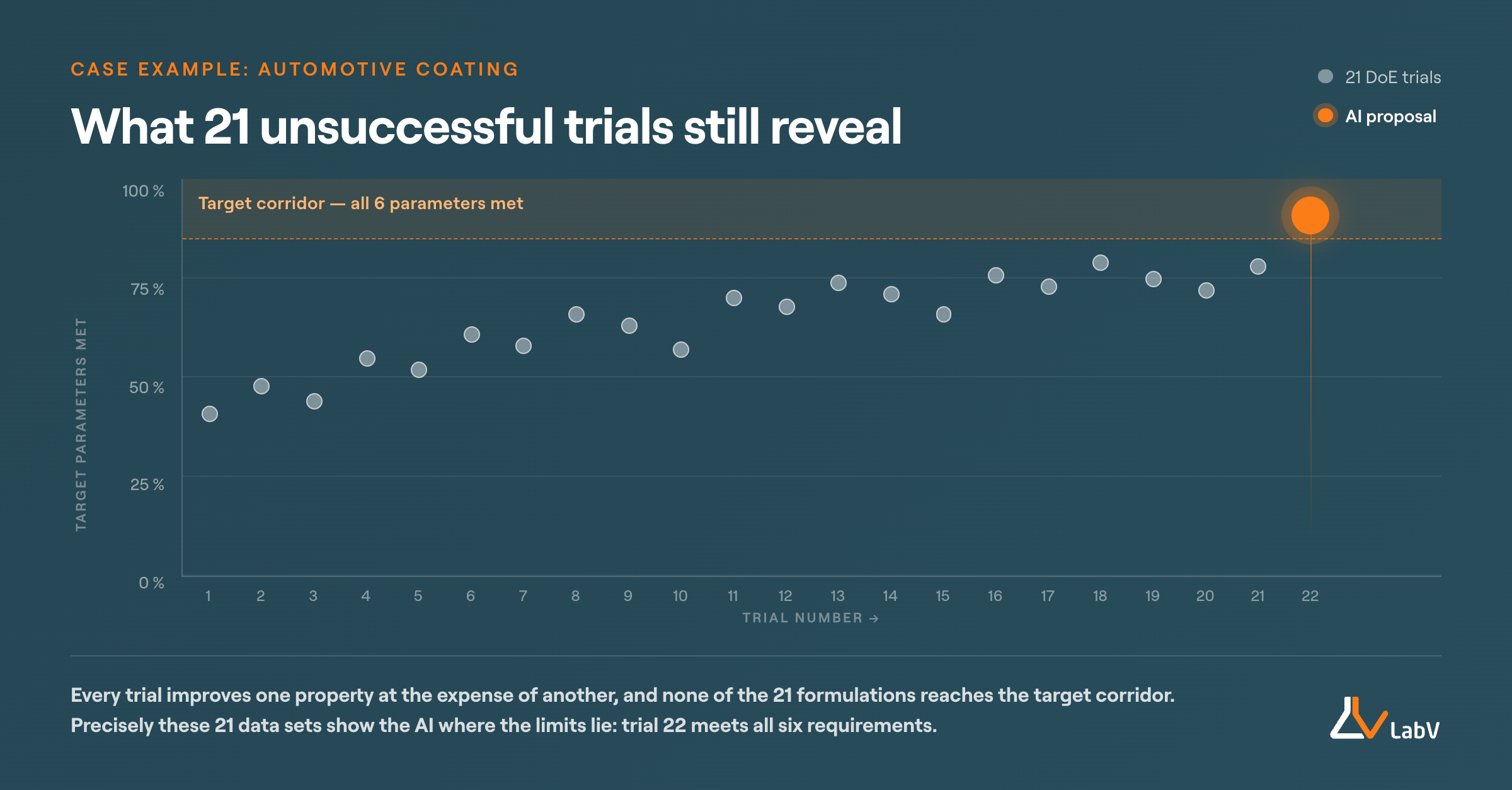
Those 21 trials were not wasted. They provided the data to build a predictive model. Using Bayesian optimisation, the team identified promising formulations from the existing trial data, without additional laboratory trials to narrow down the candidates. A single laboratory trial of the recommended formulation then met all six target parameters.
Predictive AI helps decide what to test next
In R&D, a predictive model can estimate properties such as viscosity, curing time or mechanical strength from a given set of inputs. AI-supported experiment planning goes one step further by helping teams decide which experiment to run next.
One practical example shows how predictive AI helped improve a complex wall paint. The team used 192 existing customer formulations to create a digital twin of the product. Each formulation contained 18 to 25 ingredients, resulting in around 1058 theoretically possible combinations. No team could test all these formulations in the laboratory.
Each week, the optimisation algorithm proposed new formulation candidates to provide the most useful information when tested. The results informed the next round. After only 100 trials, the model could accurately predict all target properties, including low gloss, high contrast, high viscosity and wet scrub resistance.
Sometimes the most useful experiment is an uncertain one
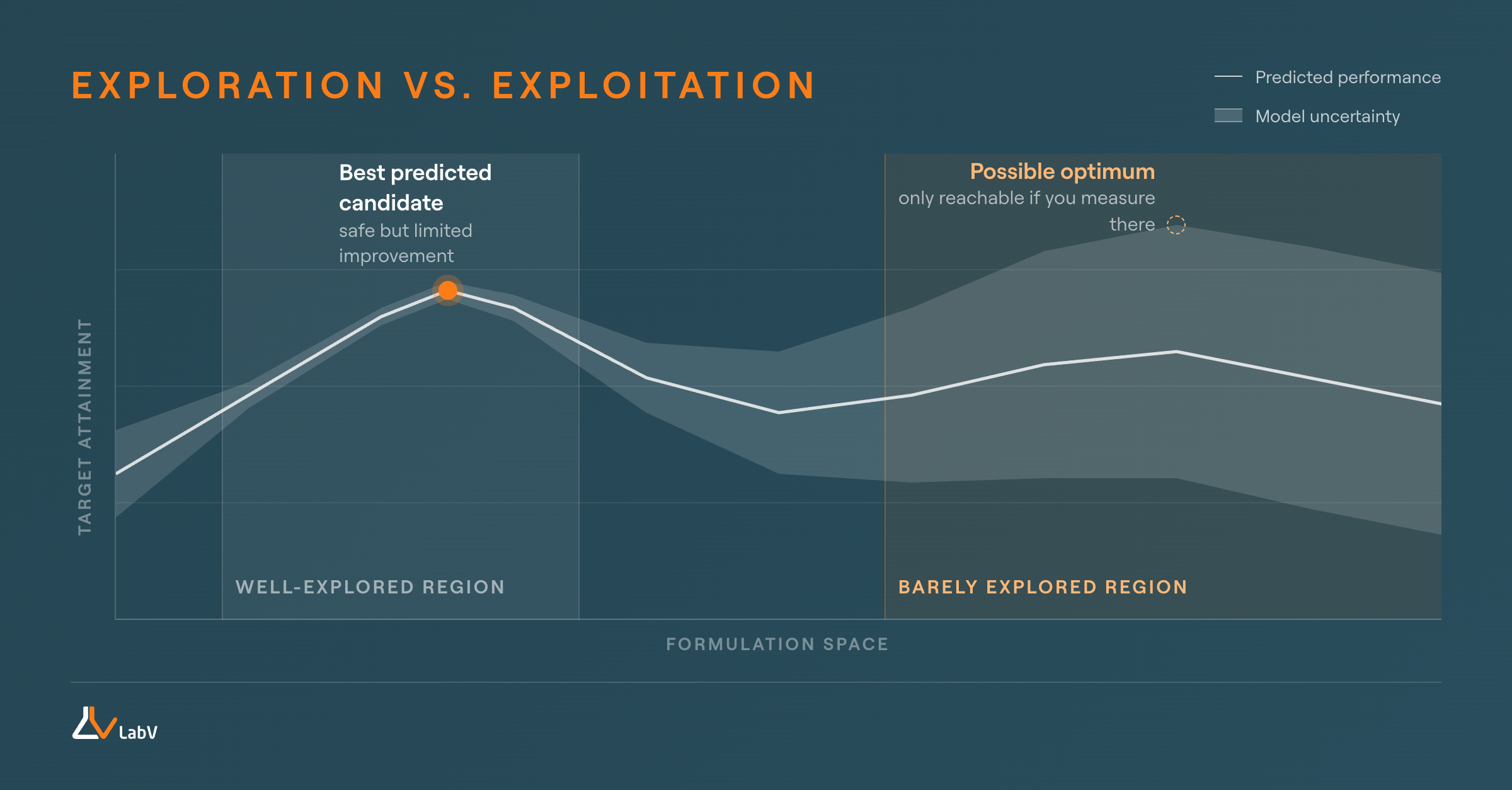
Bayesian optimisation balances exploration and exploitation to help teams decide what to test next. Exploration tests formulations whose outcomes are less certain. These experiments may reveal relationships that have so far been overlooked. Exploitation focuses on formulations expected to perform well. The formulation with the highest predicted performance is therefore not automatically the best one to test next. Sometimes the most valuable experiment reveals an interaction between raw materials that neither experience nor the available data would lead the team to expect.
Not every project needs new trials
A solvent-based ink project shows how existing data can reduce the need for new trials. Results from 2,000 historical experiments were used to build a predictive model, achieving a median prediction error of only 8 per cent compared with measured laboratory values, without any new trials being necessary. The model also helped screen a list of 141 candidate materials to select 8 to 12 raw materials for each formulation before any laboratory sample was prepared.
These examples start from different situations but follow the same underlying principle. Sometimes the existing data is already sufficient for reliable predictions. In other cases, a carefully planned, manageable set of new trials is needed to give the model enough data to make reliable predictions.
The raw materials may already be in the laboratory
These examples show that innovation does not always have to start from scratch. A breakthrough does not necessarily require an entirely new raw material or an unexpected discovery. For many R&D teams, the results of years of experiments already hold some of the knowledge they need. Formulations, measured values, unsuccessful trials, process parameters and observations together form a record of what has been tried and learned. Much of this knowledge is difficult to use systematically when data is spread across spreadsheets, laboratory notebooks, instrument exports and specialist systems. Materials may also have different names across departments, and measurements may be recorded in different units.
Before a model can provide meaningful recommendations, the underlying data must be organised so it can be compared and interpreted. Structuring formulation data requires clarity about which material names refer to the same raw material, which measurements are comparable and which process conditions influenced a result.
R&D expertise remains central
Being able to search a larger formulation space does not mean handing development decisions to an algorithm. R&D teams define which properties matter, which variables may change and which constraints are fixed. They identify physically implausible recommendations and understand scale-up effects, measurement anomalies and process details. A formulation with excellent predicted performance may depend on an unavailable raw material or may not be economically viable to produce. Such constraints must be part of the development brief from the outset. Predictive AI supports teams in evaluating many more possible combinations within these limits. R&D teams provide context and causal understanding and remain responsible for the results.
Where LabV comes in
To make reliable predictions and recommend which experiments to run, predictive AI needs structured data that models can learn from. This is where LabV comes in. The platform brings formulation, process and measurement data together in a common structure so they can be used in AI-supported formulation development.
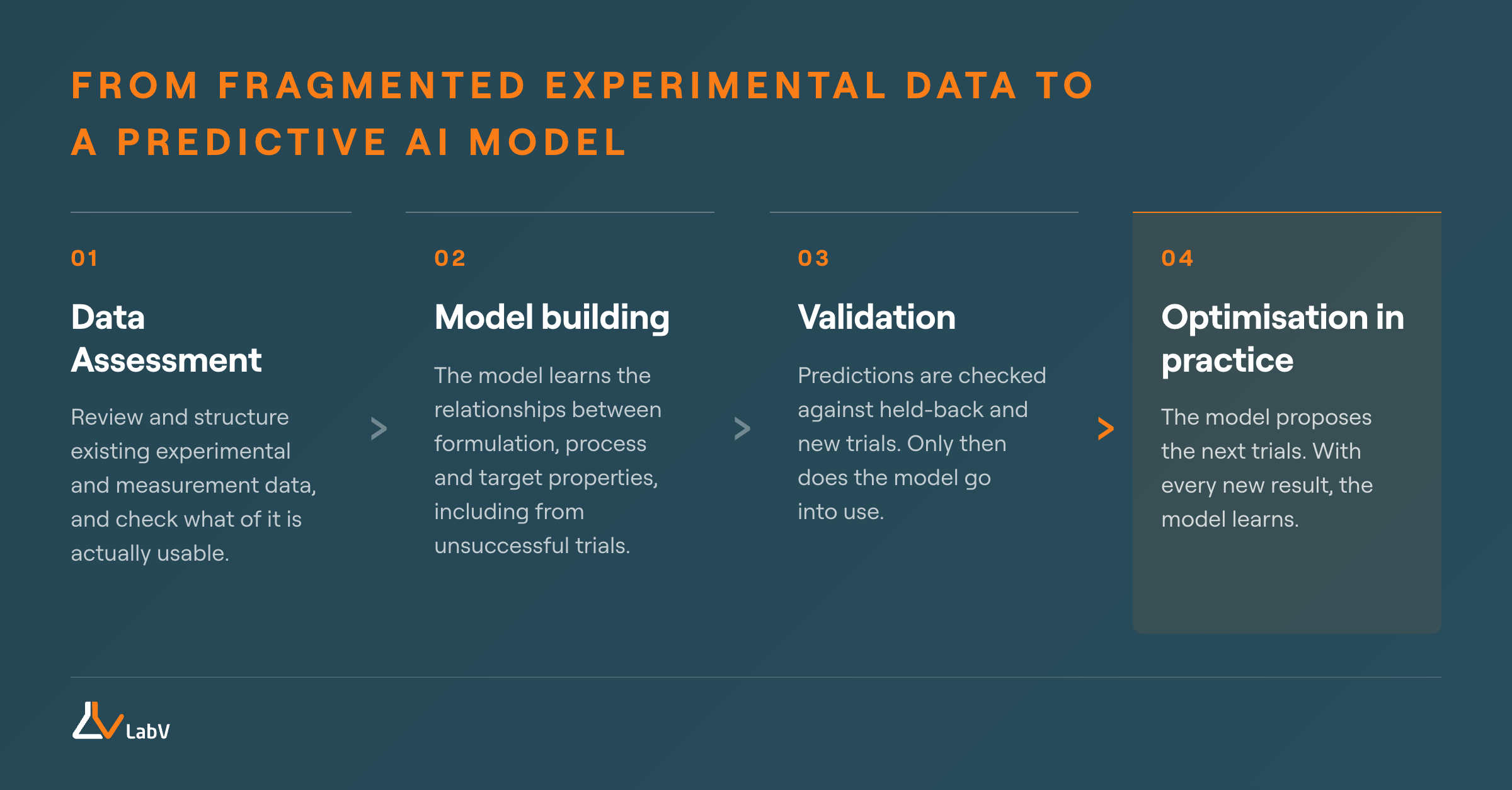
A typical project follows a clear process. During the Data Assessment, the existing formulation and trial data are reviewed to determine whether they provide a suitable basis for the model. The result is a go or no-go recommendation and a detailed project roadmap. During the Foundation phase, an existing industry model is adapted or a customer-specific model is built, incorporating optimisation targets, the design space and constraints. An initial model is then trained and validated using historical data. If its accuracy is not yet sufficient, it is refined using additional data and carefully chosen or newly derived input variables. Only when the model meets the required quality criteria is it used for optimisation. In each round of laboratory testing, the model recommends the most promising formulations until the defined targets are met.
A senior chemical engineer at a global automotive coatings manufacturer described what this meant in practice: in her project, the model delivered results that her own DoE approach had not achieved.
A different perspective on R&D productivity
Focusing only on how AI can accelerate existing development processes underestimates its potential. Reducing the number of experiments matters, as do shorter development cycles and more accurate predictions. The great strategic opportunity lies in investigating questions that were previously too costly or complex to address systematically: Could substituting a raw material lead to a fundamentally different formulation structure? Could earlier trial data reveal promising areas of the formulation space that have so far received little attention?
Answering such questions requires sufficient formulation data. The Roman engineers offer a useful parallel: their understanding of materials allowed them to turn seawater, normally a weakening factor for ordinary concrete, into a source of additional strength. Existing formulation data can be viewed in a similar way. At first glance, historical, incomplete or unstructured datasets may seem like a limitation. However, properly prepared, they can provide the basis for predictive AI.